The Bengal cat is gentle yet possesses a wild beauty characteristic of leopards. It is always energetic, with the confidence and alertness of an athlete, and a strong curiosity about things, yet it is not aggressive.
It is a straightforward pacifist. Its adorable and intelligent appearance also wins the hearts of many. Owning a Bengal cat means you can take it to play in the water, let it play with dogs, and let it romp with children. The Bengal cat is just that kind of "wild child." 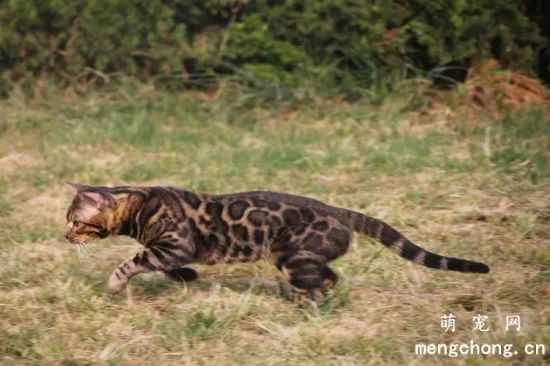
Bengal cats are not considered an obese breed. Many owners find their Bengal cats are too thin. Cats in their growth period have high nutritional expenditure and may not be getting enough calories, so it's necessary to replenish their energy by switching to a higher-fat cat food. However, calorie supplementation should be moderate; a beautiful Bengal cat needs a muscular physique, not a flabby one.
Bengal cats enjoy exercise, so cat trees should be added to their enclosures as exercise areas. Adequate exercise is crucial for maintaining their muscular build and excellent jumping ability.
Jean Sudden Mill was the first to successfully breed the Bengal cat, a new breed of domestic cat. In 1963, she crossed a male black shorthaired domestic cat with a female Asian Leopard Cat (ALC). The aim was to create a new breed with the beautiful markings of an ALC but the docile temperament of a domestic cat. Initial experiments and the offspring produced through crossbreeding proved that ALCs and domestic cats could indeed produce offspring. However, some accidents involving the Mill family subsequently led to a temporary halt to these experiments.
Research on pet cat websites reveals that in 1975, Jean obtained eight female ALC (Alternanthera leukemia) offspring from Dr. Willard Centerwall, a geneticist and pediatrician working at UCLA (during which time Dr. Centerwall conducted research on immunity and feline leukemia using ALC and its crossbreeding offspring). She continued her breeding program. Thanks to Mill's efforts and continuous experimentation, in 1984, the Bengal cat was finally recognized as a new breed of domestic cat with a docile temperament and stable genetic traits, and was approved as a new breed by the International Cat Association (TICA).