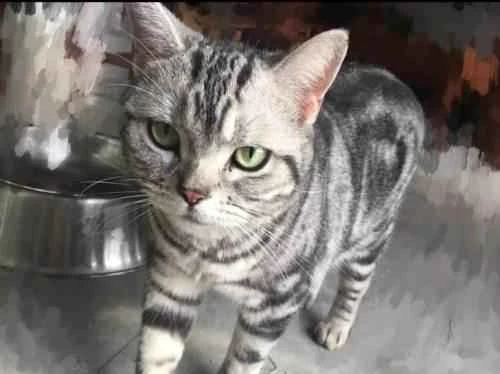
Tabby cats are known for their distinctive stripes, and their various patterns have become a hot topic of discussion among cat lovers. Below, the Cat Encyclopedia section will guide you through learning about the characteristics of different tabby cat stripes:
Classic Tabby Pattern:
Dense, clear, and broad markings; leg rings connect with body markings. Tail markings are ring-shaped. The neck above the chest has numerous complete collar-like rings. The forehead has wrinkled markings resembling the letter "M". Continuous linear markings extend from beside the eyes, encircling the cheeks. A vertical line on the top of the head extends to the shoulders, forming a butterfly-shaped marking with distinct dots. Three straight, parallel stripes from the butterfly markings to the tail evenly divide the back. Larger spots are surrounded by one or more continuous markings on each side of the body, with the shape and color on both sides as identical as possible. Numerous spots are present on the chest and abdomen. The joints are the same color as the markings. 
Mackerel Tabby Pattern:
The body has dense, clear, and narrow stripes, with ring-shaped stripes on the legs connecting to the body stripes. The tail has stripes resembling a wooden fence. Clear stripes on the chest and neck resemble many chains. The forehead has wrinkled stripes resembling the letter "M". Continuous linear stripes extend from the corners of the eyes, encircling the cheeks, with a vertical line extending from the top of the head to the shoulders. The stripes on the back converge to form a narrow saddle shape. All parts of the body are covered with narrow stripes. The joints are the same color as the stripes.
Patched Tabby Pattern:
Patch spots specifically refer to silver, brown, or blue standard spots with red or cream-colored patches.
Silver tabby (Silver Classic Tabby, Silver Mackerel Tabby):
The overall color, including the lips and jaw, is pale white with a clean silver hue. It has dense black markings. The silver markings are genetically inherited from a gradient pattern similar to that of a guinea pig, so the undercoat is white. The nose is brick red. The paw pads are black. The eyes are green or light brown, with green being ideal.
Brown markings (Brown Classic Tabby, Brown Mackerel Tabby):
The overall color is a brilliant, coppery brown. It has dense black or dark brown markings. The lips, jaw, and the ring around the eyes are a slightly lighter brown. The back of the legs, from the claws to the base, are black. The nose is brick red. The paw pads are black or brown. Bright gold eyes are ideal.
Blue markings (Blue Classic Tabby, Blue Mackerel Tabby):
The overall color, including the lips and jaw, is a pale, ivory-blue. Very deep blue markings provide excellent contrast to the base color. The overall impression is one of subtle pale yellowish-brown or coppery hue. The nose is a slightly grayish-purple rose color. The paw pads are rose-colored. The eyes are bright gold.
Silver Patched Tabby:
The undercoat is white, and the overall color, including the lips and chin, is a clean, pale silver with dense black markings of standard or mackerel patterns, and red or cream patches on the body and tip.
A reddish or creamy complexion is desirable. Eye color should be bright gold, green, or light brown.
Brown Patched Tabby:
The overall color is a bright copper-brown, with dense markings resembling standard or fishbone patterns. The lips, chin, and the ring around the eyes are a slightly lighter brown. The eyes are bright gold.
Blue Patched Tabby:
The overall color, including the lips and jaw, is a pale, ivory-blue, with dense, very deep blue markings of standard or fishbone patterns providing excellent contrast to the base color. The body and limbs have distinct cream-colored patches. A creamy hue on the face is desirable. The overall impression is a faint pale yellowish-brown or coppery-brown. The eyes are bright gold.
Red markings (Red Classic Tabby, Red Mackerel Tabby):
The overall color is red, covered with dark red markings. The eyes, lips, and area around the chin are the same lighter color. The nose and paw pads are brick red. The eyes are bright gold.
Creamy Tabby (Cream Classic Tabby, Cream Mackerel Tabby):
The entire body, including the lips and chin, is a muted cream color. There are light yellow or cream-colored markings that are darker than the base color. The nose and paw pads are pink. The eyes are bright gold.
Cameo Classic Tabby (Cameo Mackerel Tabby):
The overall color is grayish-white with red undertones. They are typically shaded cats with light and dark stripes similar to those of a guinea pig, resulting in a white undercoat. The nose and paw pads are rose-colored, and the eyes are bright gold.
Creamy Cameo (lighter Cameo):
The undercoat is white, the rest of the coat is grayish-white with cream-colored markings, the nose and paw pads are pink, and the eyes are bright gold.
Add white markings (TABBY AND WHITE includes the Sanskrit word Vans):
Among other colors with markings (including standard markings and mackerel markings), the lowest preferred appearance is a cat with white parts of its body, including white paws, legs, lower abdomen, chest, and muzzle, with an inverted V-shape on the side of the body being the best.
Silver striped with white (including standard silver striped with white and silver fishbone striped with white):
This means the cat has white markings. Eye color: bright gold, green, or hazelnut.