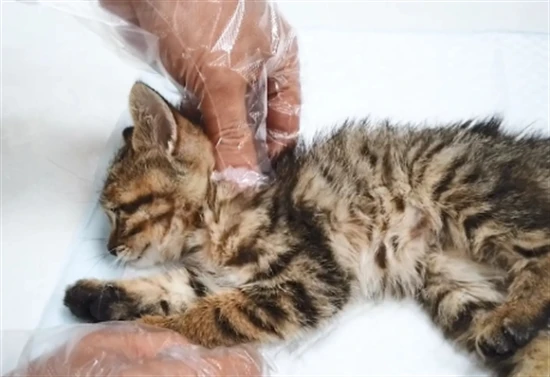
In our daily lives, we often check our heart rate, pulse, and blood pressure periodically to understand our recent health status. Cats also have some routine checks, such as body temperature and pulse. These checks are very convenient and can be done at home. Of course, we must first master the correct methods to obtain useful data. 
Cats' temperatures are typically measured rectally. A human thermometer can be used, but once used on a cat, it should not be used on a human. Alternatively, a rectal thermometer, such as the kind used for children, can be used. Before measuring temperature, shake the mercury column of the thermometer below the lowest mark. If it has graduations, zero it first. Then, disinfect the thermometer with an alcohol swab. The alcohol used for disinfection must be pure and uncontaminated. If you have difficulty inserting the thermometer, you can apply a small lubricant. Secure a small clip to the back of the thermometer to prevent it from falling out during measurement.
After preparing everything, we lift the cat's tail base slightly and then slowly insert the thermometer into its anus. Be careful not to insert it too quickly or too forcefully, otherwise it may damage the rectal wall. After insertion, secure the clip to the cat's back fur.
The temperature measurement time is generally 3 minutes. After 3 minutes, gently remove the thermometer, clean off any dirt, and then read the temperature. An adult cat's body temperature is 38.1~39.2℃. A cat's temperature is usually lower in the morning and higher in the evening, but the difference should not exceed 0.5℃. If the temperature is higher or lower than normal, the cat may be sick. Of course, there are errors in temperature measurement. For example, hot weather, the cat eating, or after exercise, returning from a walk, or when the cat is excited or nervous can all cause a slight increase in temperature. Other factors, such as a relaxed anus or diarrhea, can also affect the measurement.
A cat's fever is usually a sign of infectious diseases, or inflammation. A low body temperature, however, should be taken very seriously, as it could be a sign of severe exhaustion or impending death.
Checking a cat's pulse is quite simple. The usual place to check a cat's pulse is on the femoral artery on the inner thigh. Just like with humans, find the artery by feeling for a pulsating area. If the pulsation is weak, you're not looking in the right spot; check the surrounding area. An adult cat's pulse is typically between 110 and 240 beats per minute. The pulse may increase if the cat is exercising vigorously, excited, overheated, or pregnant. Kittens generally have a higher pulse rate than adult cats.
An increased pulse rate can be seen in some febrile illnesses, heart diseases, or anemia, while a decreased pulse rate may be caused by hydrocephalus or drug poisoning.
Of course, if the cat struggles or resists during temperature and pulse checks, remember to restrain it first.