The Norwegian Forest Cat's origins can be traced back to ancient times. It is believed to have evolved from cats brought back by 13th-century Vikings from Asia Minor (Caucus, Anatoly, etc.) to control rats harassing their ships. Another possibility is that it was brought by Central European or Asian tribes who migrated to Scandinavia before the Middle Ages. Cats migrating from other regions may have adapted to the harsh Scandinavian climate, evolving a thick, double-layered coat to withstand the cold. These cats also likely increased in weight and size. 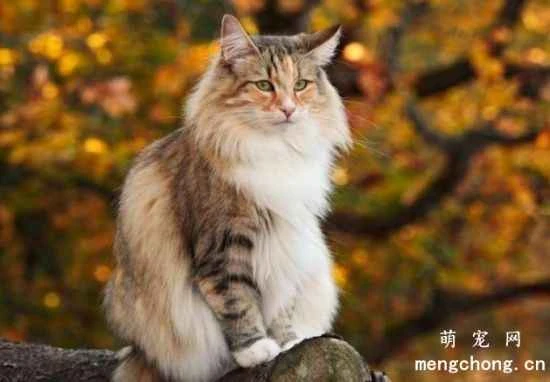
However, it is not a descendant of a cross between a Norwegian Forest Cat and a Persian cat, because when the Norwegian Forest Cat appeared in Norway, the Persian cat had not yet entered Norway. However, after the Persian cat came to Northern Europe, the Norwegian Forest Cat may have mixed with the bloodline of the Persian cat. The Norwegian Forest Cat has lived in the Norwegian forest for a long time. Due to the harsh climate and other reasons, its numbers have decreased year by year and it is in danger of becoming extinct. It is a long-haired cat unique to Northern Europe.
In ancient Norse mythology, there are two gray cats, as strong as lions, who pull the chariot of a goddess across the sky. These cats are incredibly strong and enormous, and the myth has been passed down orally from generation to generation. The enormous cats in the myth bear a striking resemblance to the modern description of the Norwegian Forest Cat. Therefore, the origins of the Norwegian Forest Cat can be traced back thousands of years.
Because this myth had long been told orally, it wasn't until 1835, when folklorist Peter Christian Asbjørnsen and poet Jørgen Moe wrote and published a selection of Norwegian folk tales and songs, that the Norwegian Forest Cat became widely known.
However, the long-haired cats that originally lived in the forests, due to interbreeding with ordinary short-haired domestic cats, and because the short-haired gene is dominant while the long-haired gene is recessive, most of their offspring became short-haired. Purebred long-haired Norwegian Forest Cats became increasingly rare after long-term interbreeding. In the 1930s, Norwegian purebred cat breeders began to pay attention to the gradual disappearance of this legendary cat and began planning a breeding program. Because finding completely purebred and standard-compliant Forest Cats was extremely difficult in the early days, the breeding program essentially stalled. A group of passionate breeders dedicated to protecting the Norwegian national cat continued their tireless efforts and achieved remarkable results. Before World War II, Norwegian Forest Cats were already appearing at cat shows in Oslo. In 1973, after years of hard work, the Norwegian Forest Cat was recognized by the FiFé in Paris, France, and listed as a FiFé-approved purebred cat.