1. Siberian cat
Possibly a hybrid of domestic cats and local wildcats from Siberia and Ukraine. Its thick, warm coat is well-adapted to the harsh local climate. The breed's female, Mussa, and male, Tima, with red and white tabby markings, were purchased and brought to Berlin in 1987. Hans Schulz and Betti Schulz bred the first generation of Siberian cats at their Newski cattery. It was recognized by the FIFe in 1987. In 1990, Elizabeth Terrell introduced the first cats to her Starpoint cattery in the United States. TICA recognized the breed and published its standard in 1998. 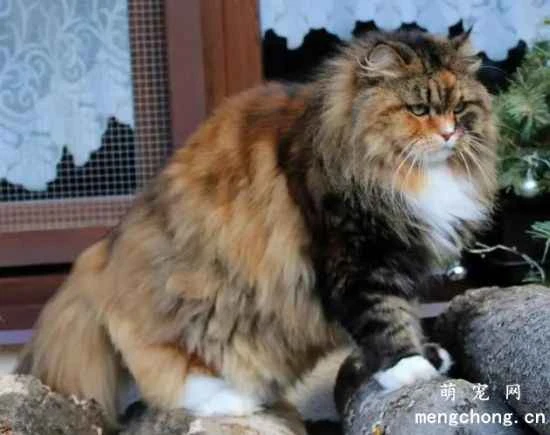
The Siberian cat originated in the harsh northern climate of Russia, hence its thick coat. While possessing a wild nature, its gentle appearance gives it an approachable charm. Besides captive breeding, naturally bred varieties are a relatively recent development. Although selective breeding has not yet been implemented, similar to the Norwegian Forest Cat, another northern breed, some have begun formal breeding programs. This cat is quiet yet powerful, and quite active, even very active. Despite its strong personality, it is very friendly towards other cats. They are playful and get along well with children. They are affectionate and very attached to their owners. They have a soft voice.
2. Russian Blue Cat
The Russian Blue is a naturally occurring breed of cat that originated in Arkhangelsk, Russia (also known as the "Blue Angel" port), hence its coat color is also called "angel blue." Evidence suggests that this cat indeed originated in Russia, as similar breeds have been found in the cold regions of Russia. The Russian Blue is therefore also known as the "aristocrat of short-haired breeds" and the "winter elf." 
The Russian Blue cat originated outside of Russia in the 19th century. It is said that in the 1860s, sailors brought them from the Arcantieri Islands to England and Northern Europe. In 1875, it was first registered as an Arcantieri cat at the Crystal Palace in England. It wasn't until 1912 that the Russian Blue was given a formal classification compared to other blue cat breeds, such as the English Blue, French Château, and Thai Korat. The Russian Blue has had three different names: Archian Blue, Maltese, and finally, in the 1940s, its current name.