Originating in the cold Siberian region, the Russian Blue is often referred to as the "Winter Elf." Its evolutionary history is quite long; its ancestor, the Archangel Blue, was brought to England from Russian ports as early as the 17th century. After World War II, the Russian Blue population declined sharply. To restore its numbers, breeders crossed it with Siamese cats, giving the Russian Blue a somewhat oriental appearance. Because of its ancestral origins in the cold Siberian region, it is often called the "Winter Elf." 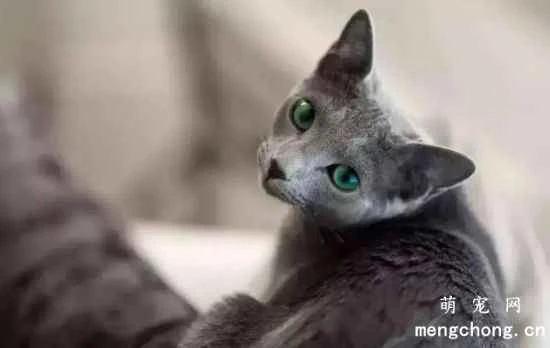
The Russian Blue is a naturally occurring breed of cat that originated in Arkhangelsk, Russia (also known as the "Blue Angel" port), hence its coat color is also called "angel blue." It is said that Russian Blue cats were brought to England and Northern Europe by sailors from the Arkhangelsk Islands ("Blue Angel Islands") in the 1860s. They were first registered as Arkhangelsk cats (or "Blue Angels") at Crystal Palace in England in 1875. It wasn't until 1912 that the Russian Blue was given a formal classification in comparison to other blue cat breeds (such as the English Blue, French Château, and Thai Korat).
Initially, Russian Blue cats were only bred in regions outside of England and Scandinavia after World War II. Due to transportation disruptions during the war, the purebred Russian Blue's lineage narrowed, leading some breeders to crossbreed Russian Blues with Siamese cats. Although this hybrid existed in the United States before the war, it was only after the war that breeders developed what is now known as the "modern Russian Blue" in the US. While breeders used Russian Blues to create new breeds, such as the Havana Brown (with a coat color resembling a Havana cigar and Siamese ancestry) or new lines, such as the Nibelung (whose name comes from the German word for "a creature as misty as frost," reflecting its beautiful appearance), the Russian Blue's lineage remained that of a short-haired cat with a grey-blue coat.
In the early 1970s, an Australian cat breeder named Mavis Jones bred a pure white Russian Blue (which became known as the "Russian White") by crossing Russian Blue cats with native white cats. By the late 1970s, the Russian White and Russian Black were recognized by Australian cat lovers as Russian breeds. However, even though the International Federation of Cat Breeders (IFC) and the American Cat Fanciers Association (ACFA) recognized the Russian White and Russian Black as transitional breeds for the Russian Blue, the Cat Fanciers Association (CFA) itself refused to acknowledge this variant of the Russian Blue.