There's a saying that goes, "Love is always feeling indebted."
Cat owners can probably relate: they're always worried that their cats aren't eating, sleeping, or playing well. When they see other people's big houses or playgrounds, they secretly worry about their own small rooms, wondering if their cats will find the space too cramped.
Of course, there are also some irresponsible owners who casually lock their cats in cages or in some room, completely disregarding the cats' feelings, which is appalling to watch.
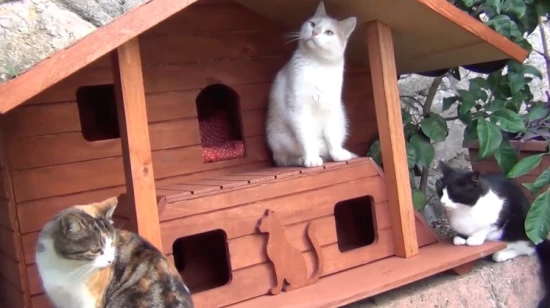
Let's have a serious talk about how much territory cats actually need, and how they should develop their little home.
Wealthy families simply go bigger and bigger!
cat territory size
If you only look at the marked area, wild cats roam a very large area. The territory of an unneutered male cat is usually more than 0.6 square kilometers, and that of a female cat is about 0.16 square kilometers. The core area, which is the cat's "base," where they sleep and eat safely, is about 100 meters in diameter.
Studies have found that even "free-roaming" pet cats have a considerable territory. Although they prefer to stay at home most of the time, their activity range can extend to within 0.02 square kilometers of their home.
Don't let your cat roam freely! This is just research data!
A cat's territory is not absolute; it may change with changes in resources and environment, and the cats may be scattered in different places rather than forming a single area.
If resources are plentiful, many cats can live in the same area. For example, the cat density in a neighborhood is quite high; it's not entirely exclusive.
As for fully domesticated cats, a cat's living space should be at least 18 square feet (1.67 square meters). However, this is only the core area for eating, drinking, and eliminating waste. The specific amount of activity space a cat needs is recommended to be more than 28 square meters. Of course, it also depends on the cat's size, personality, and energy level.
What to do if you have multiple cats?
Multi-cat households may find that the cats have their own "hierarchy." For example, after buying a new cat tree, one cat will often be the first to claim a spot and scratch and rub against it. The places where cats usually stay will also change.
Therefore, if the cats get along well and take turns reserving seats, you don't need to disturb them too much.
It's recommended to give each cat its own dedicated territory, such as a cat tree with at least one cat's capacity, or a cat tree with multiple footholds. When buying scratching posts and toys, try to provide one for each cat.
If your cat exhibits aggressive behavior, marks itself with urine, or shows signs of territoriality, as well as excessive grooming and meowing, it may mean that your cat needs more space!
Making your small home feel "bigger"
Respect the cat's preferences
There must be a place that is the cat's most important "home". You can observe whether the cat likes to sleep in a certain place. When the cat is in that place, try not to force them out.
When buying "cat furniture," you should also consider your cat's preferences. Some cats prefer secluded corners (?), so you can choose cardboard boxes or semi-enclosed furniture. Others like to lie flat, so choose flat, open furniture.
Remember that a cat's territory can change!
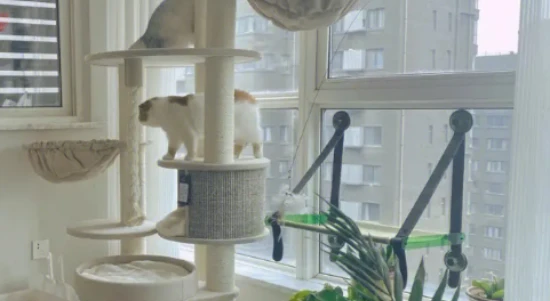
Development space
Cats love to stand on high places to observe their surroundings. You can find ways to expand vertical space, such as cat trees, furniture cabinets, or windowsills, by placing suction cups or small shelves to satisfy their climbing instincts and make them feel safer.
For multi-cat households and small families, increasing vertical space is especially important.
You can also provide your cat with more hiding places, such as winding cat tunnels or furniture arranged at varying heights—it's both fun and provides excellent hiding spots!
Sufficient resources
Make sure your cat has easy access to basic resources such as food, water, and litter. In fact, many popular "cat corners" are not a good practice (the food bowl, water bowl, and litter box are all in the same place), because cats don't like to eat, drink, and relieve themselves in the same place.
Multi-cat households should also be careful not to pile up similar resources together, such as making cats sit in a row to eat, as this can easily cause pressure for the cats to compete for resources.
Human participation in play
Provide your cat with fun toys, such as treat dispensers and cat wands, to encourage them to run around and mimic hunting behaviors. This is especially important for newly adopted stray kittens who may be used to a nomadic lifestyle and won't be able to relax all at once. Spend a lot of time playing with them to expend their energy. Remember, when discussing a cat's happiness, it's not just about the size of the space or simply providing a safe haven for them. It's about creating a unique and comfortable environment for your cat—a home where both you and your feline companion are happy.