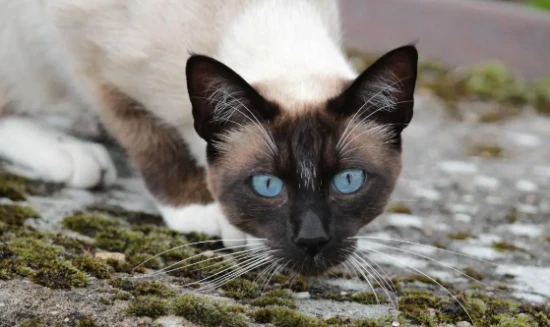
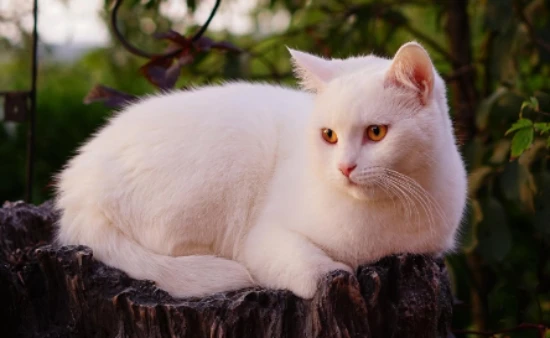
Cats, as companion animals to humans, have accompanied us for a very long time. However, although cats have always been around us, their temperament is unpredictable; sometimes aloof, sometimes affectionate, you never know when a cat will approach you. This leads us to a fundamental question: why did cats initially choose to be domesticated by humans? Did they approach humans to obtain food and ensure their survival, or were there other purposes, or some innate factors? 
According to Stephen O'Brien, head of the Dobzansky Center for Genetic Bioinformatics, over 10,000 years ago, with the development of agriculture, humans began to have a certain surplus of grain. Cats, as "foodies," came to human settlements, roaming near human dwellings in search of food. During this process, some wild cats, less afraid of humans, stayed and became the ancestors of today's domestic cats. This friendliness towards humans was later strengthened through genetic transmission. It can be said that humans did not domesticate cats, but rather cats chose to approach humans. Some argue that cats are not yet fully domesticated, citing the conflicted feelings of cat owners who experience both "pain and pleasure." However, recent scientific research reveals the genetic changes that occurred in cats during the domestication process.
The findings of this study were published in the latest issue of the *Proceedings of the National Academy of Sciences*, following the publication of the complete feline genome map in the August issue of *Gigascience*. Domestic cats and wildcats are not genetically very different, although wildcats have slightly larger brains. However, the main differences lie in their appearance. For example, cats with white paws or long-haired Maine Coons did not exist 200 years ago. Those cats with elaborate appearances are primarily the result of artificial breeding to meet human preferences.
However, more than appearance, the biggest difference between domestic cats and wild cats is their personality, and all of this is written into the cat's genes.
By comparing the genes of feral and domestic cats, scientists discovered that domestic cats have indeed undergone some genetic mutations. These mutated genes are generally active in the spinal cord, such as those related to memory, fear regulation, and stimulus-reward learning. In everyday life, these genetic changes manifest as domestic cats willingly lying on your lap and lazily watching you, while feral cats will only peek at humans from a distance behind you. It sounds a bit like a stray cat before it becomes familiar with you.
However, unlike dogs, cats don't respond to our actions. A recent study from the University of Tokyo confirms this. The study shows that although fully capable of recognizing their owners' voices, pet cats choose to ignore them. The study tested 20 domestic cats: when their owners were out of sight, three strangers called their names, then their owners called their names, and finally another stranger called their names. Researchers analyzed the cats' reactions to each call by observing details such as their ears, tails, vocalizations, and pupil dilation.
When cats hear their own names, they exhibit locative behavior, searching for the source of the sound. The results showed that cats reacted more strongly to their owners' voices than to strangers, but they refused to respond.
This result shows that although cats can recognize their owners' voices, they do not actively respond to them. "This relationship between cats and their owners is the exact opposite of that of dogs," wrote Atsuko Saito and Kazutaka Shinozuka from the University of Tokyo in their article.
In short, don't underestimate the little bit of affection a cat gives you. You should know how many genetic mutations they've gone through to be willing to gently rub against your legs for a while. Because domestic cats and wild cats are genetically similar, and there's even interbreeding, the differences between them are minimal, aside from slight variations in docility and appearance.
How can I maintain a close relationship with my cat?
If you're initially going to cage your cat, remember to line the cage with bedding to increase comfort and warmth. Ideally, use your old clothes or sheets; they'll be filled with your scent and help it get used to your presence. Also, include a clean litter box, a full and securely placed water and food bowl, and a cat bed made of old clothes. Therefore, the cage needs to be large, preferably a double-layered cage. You can line the bottom of both layers with wood, cardboard, or old clothes, as cats find walking on wire mesh uncomfortable.
If you're planning to keep your cat on a leash from the start, make sure it's in a spacious area without any hiding places. While being leashed might be slightly uncomfortable for the cat, the advantage is more room to move around and a greater tendency to bond with people. Within its enclosure, provide a clean cardboard box with a canopy and a hole cut in the side for it to use as a bed. Line it with your old clothes or something similar. The box will also help it sharpen its claws. Remember to provide separate litter and water bowls within its enclosure. The water bowl can be kept nearby unless the cat knocks it over, but never leave the food bowl in front of it! An empty food bowl is fine, but never leave a food bowl with food in front of it. This applies to caged cats as well!