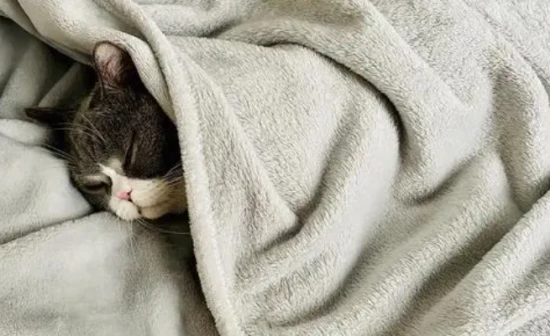
Cats won't lack oxygen when tucked in under the covers in winter. After a cat gets under the covers, how often should I ventilate the room? How often should I lift the covers to check on them? How can I feel comfortable letting my cat stay in bed without knowing these things?
Try calculating it!
Do you know how many times a cat breathes per minute and how much air it inhales each time?
A calculation method that sounds easy
Want to know how long a cat can stay in bed? It's actually quite simple!
All I need to know is how much air is in the blanket, and how many times the cat breathes per minute and how much air it needs, isn't that enough?
However, this method failed in the first step because everyone's blankets are made of different materials, cats are different sizes, cats crawl into blankets in different ways, and it's difficult to generalize about how much air is inside the blanket. (Of course, the main problem is that I don't know how to calculate the volume of an irregular space without modeling it.)
Chairman Mao said that practice is the sole criterion for testing truth. If theoretical methods don't work, perhaps we can try practice!
We can find the answer in practice!
All the fancy questions are no match for practice. We can start timing after the cat crawls into bed and see how long it usually takes for it to come out.
To get a more accurate answer, the experiment needs to be repeated, meaning it needs to be done several times. However, this is very unfriendly to cats, as it exposes them to repeated hot and cold temperatures and can easily frighten them.
We can use our knowledge of physiology to have the cat owner conduct the tests instead of the cat:
Humans need about four times the amount of air they need to breathe per minute compared to cats.
It's important to note that the breathing rate of both humans and cats is completely different when they are stressed and when they are calm.
When cats sleep at home, their breathing rate is only 20 breaths per minute, but in the hospital, when they are stressed, their breathing rate can reach 64 breaths per minute.
When your cat snuggles up to you, you can secretly count its breathing rate to know if it truly loves you.
Getting back to the main point, we now know that humans need four times the amount of air per minute as cats. Next time your cat tries to get into bed, you can first shoo them out, then keep the blanket in its original shape before conducting a breathing test inside.
Use your phone to time yourself, and maintain calm, natural breathing under the covers until you begin to feel slight discomfort. You may experience a mild headache, not due to lack of oxygen, but because the carbon dioxide concentration has started to rise, reaching approximately 0.1%.
It is not recommended that you continue to push yourself at this point. When the carbon dioxide concentration reaches 1%, it may cause symptoms such as weakness in the limbs, anxiety, and chest tightness.
Stop when you feel uncomfortable, and multiply the time you stayed inside by 4 to roughly estimate how long the cat can stay inside! If you want more accurate data, you can test it several times.
To be more serious, although in most cases our blankets cannot form a completely sealed environment, it seems that there is no problem for cats to stay in them.
However, there have been cases where kittens died after being placed under blankets by their owners. Since cats like to burrow under blankets in winter, it's best to leave a small opening for ventilation.