Summer is here, and you want to give your cat a nice bath, but things inevitably spiral out of control, just as expected. The cat is stressed, and so are you.
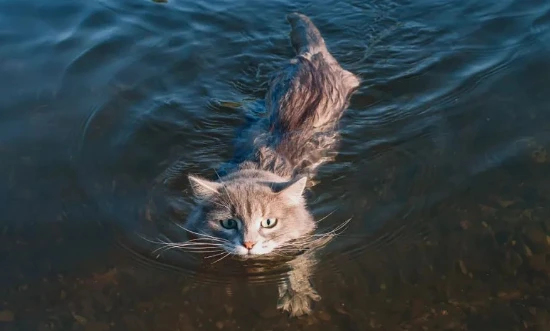
You just want your cat to be soft and smell good, so why is your feline overlord howling as if you're abusing it? Can't cats really take baths? Why is bathing so terrifying for them?
Fear of water is written into DNA
Unlike dogs, domestic cats have not completely lost their wild nature during the domestication process, and their appearance and behavior are very similar to their wild cat ancestors.
If you trace the evolutionary tree of domestic cats, you will find that cats' dislike of water is actually written into their DNA.
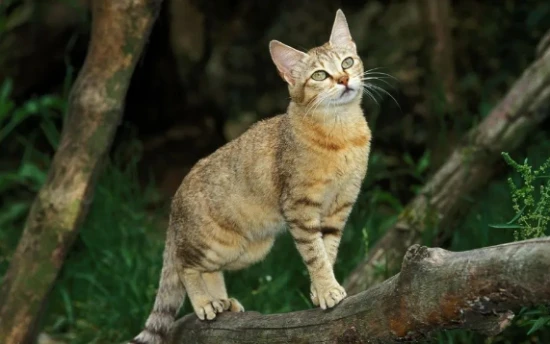
Modern genetic analysis shows that almost all modern domestic cats worldwide share DNA nearly identical to that of the African wildcat (sylvestris lybica). It can be inferred that this nocturnal hunter, inhabiting grasslands, deserts, or bushlands, is the ancestor of the domestic cat.
African wildcats live in arid environments and rarely have access to large bodies of water, so they don't really need swimming skills to get food.
They can obtain the water necessary for survival from their prey, and their strong kidneys ensure they don't become dehydrated. In addition, the presence of large carnivores near water sources further diminishes their interest in swimming. This indifference to water, or even vigilance, has been passed down to domestic cats.
On the other hand, cats' fear of water is not only an evolutionary behavioral preference, but also related to their furry appearance.
Most cats' fur is not waterproof. If you look at an animal's fur under a microscope, you will find that the surface of the fur is covered with layers of scales, like tiles.
Generally speaking, the smaller the contact angle between the scales and a water droplet, the easier it is for the fur to be soaked. Cat fur has a wavy scale structure, and the angle between the scales and the water droplet is often less than 90 degrees. Compared to mink fur, which has long, finger-like structures, its water resistance is not very good.
Once submerged in water, every single hair on a cat's fur can become completely soaked. The unusually heavy, wet fur not only makes the cat uncomfortable but also hinders its movement and makes it prone to losing its balance.
In addition, fur plays an important role in regulating body temperature for cats.
The excellent insulating effect of animal hair is actually achieved through the air trapped between the hair strands. The scales increase the gaps between the hair strands, trapping a large amount of air, thereby slowing down airflow and reducing the rate of heat exchange.
Once a cat's fur gets wet, it not only loses its insulating layer of air, but also loses heat as moisture evaporates.
A cat's physical experience of taking a bath is probably similar to jumping into a swimming pool wearing a full set of water-resistant sweater and thermal pants—not only does it feel awkward, but it also makes you shiver with cold. It's hardly a pleasant experience.
So, how do cats keep themselves clean?
When cats lick their fur, they're actually applying oil.
First, the cat's understanding of "cleanliness" differs somewhat from that of humans.
Cats' sweat glands are located only on their paw pads, which are not covered by fur. They don't sweat; they only produce oil. And oil isn't considered "dirty" by cats. On the contrary, the oil moisturizes their fur, providing good protection and sometimes even repelling small raindrops.
Therefore, cats lick their fur daily not to remove oil, but rather to stimulate the sebaceous glands and spread the oil evenly on their fur.
Besides cleaning the dust and parasites clinging to their fur, their main task is to remove body odor. As ambush predators, their instinct is to eliminate the smell and prevent prey from fleeing at the mere whiff of it.
This is where the tongue comes in—a cat's natural bathing tool. Anyone who has been licked by a cat will vividly remember the sandpaper-like texture. A cat's tongue is covered with barbs-like protrusions. Like human fingernails, these protrusions are mainly composed of keratin.
Under a microscope, the hook-shaped protrusions resemble the curved structure of a shoehorn. It combines combing, cleaning, and massage functions in one highly efficient way.
The direction of these protrusions is not fixed. When a cat's tongue encounters a knotted tuft of fur, the protrusions rotate and penetrate deeper into the tuft, eventually loosening it.
Furthermore, by rotating, the flexible protrusions can not only clean the cat's longer, sparser outer fur, but also reach their skin and the shorter, down-like underfur near the skin.
Furthermore, the curved structure allows these protrusions to absorb saliva using surface tension, applying it as a natural shampoo to the cat's body. In a day, a cat's tongue can transfer up to 48 milliliters of saliva onto its fur.
In other words, every ten days, your cat will use the same amount of saliva as a regular bottle of mineral water to bathe itself.
When you bathe your cat, you not only wash away the oil it has painstakingly accumulated, but you may also leave it with a scent that you find pleasant but it finds pungent. From the cat's perspective, this whole ordeal only increases its workload in cleaning.
Don't wash your cat unless absolutely necessary.
Within the vast family of cats, there are exceptions. Some breeds, such as the Bengal cat, which resembles a small leopard, remain motionless during a bath but play in the water like a water monkey. Anyone who sees them would exclaim in surprise, "Is this a fake cat?"
In addition, there are individual differences among cats. Just as humans are instinctively afraid of heights, some people still enjoy bungee jumping. Some cats are not breeds that are not afraid of water, but they can still live in harmony with water with ease.
Most of these brave cats are exposed to water from a young age. If kittens are exposed to water early on, they are more receptive to it than adults. Therefore, they adapt well to the feeling of being enveloped in a transparent liquid.