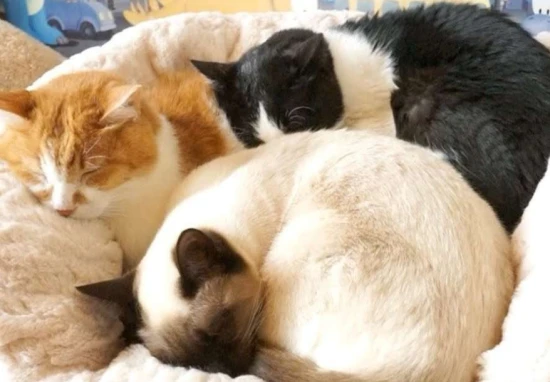
Pet owners put collars and bells on their cats mainly to track their movements, accurately determine their location, and prevent them from getting lost. However, many pet owners have their own opinions on whether or not to put such collars on their cats, so let's look at the pros and cons of this issue. 
It's undeniable that putting a Ragdoll cat in a collar carries certain risks. When the cat plays or scratches, the collar might become too tight around its neck; or when the cat is uncomfortable with the collar and tries to remove it with its claws, it might get its paws stuck in the collar; furthermore, wearing the collar for extended periods without proper adjustment can cause hair loss around the neck. However, most of these risks are due to incorrect wearing methods or an unsuitable collar choice, and therefore can be largely avoided.
1. Choose a suitable collar. When putting on a collar, ensure there is a gap of one or two fingers between the cat's neck and the collar; it should not be too tight or too loose. The collar width should not be too wide, less than 2cm is suitable.
2. Choose a pet safety collar. A safety collar has a specially designed buckle that automatically breaks when subjected to excessive force, preventing injury to the cat. Another type of safety collar has an elastic band that extends if the cat gets stuck.
3. Regularly check the tightness of the collar. For rapidly growing kittens, regularly check the tightness of the collar and adjust the collar size according to the kitten's growth rate.
Advantages of wearing a collar – easier to find if lost.
The saying goes, "It's better to be safe than sorry." Most of the time, we do a good job of supervising our cats, but humans are prone to oversights. These seemingly insignificant mistakes can lead to a cat escaping. For example, a door or window might not be closed properly. If the cat is wearing a collar and bell, it will make noise as it moves around, making it easier for us to find it.
It is well known that cats have very sensitive hearing, so we might think that the sound of a bell would affect their hearing. However, this claim is controversial, and there is currently no strong experimental evidence or data to support the idea that the sound of a bell damages a cat's hearing.
While the sound of a bell may not significantly affect a cat's hearing, we cannot rule out the possibility that it might cause them anxiety. After all, cats naturally prefer quiet, and putting a bell on them could potentially disrupt their daily lives.
Since the effects of bells on cats vary, if we find that our cats are very sensitive to the sound of bells and show signs of unease or discomfort, then we should not put the bell on them; if the cats do not show signs of agitation or anxiety after the bell is put on, then we don't need to worry too much about the bell's effect.
Actually, putting a bell on a Ragdoll cat isn't really necessary, as Ragdolls are a relatively docile and quiet breed. As long as you keep an eye on doors and windows, they generally won't run away. However, for some more playful cats, you can put a collar and bell on them when necessary to prevent them from getting lost.