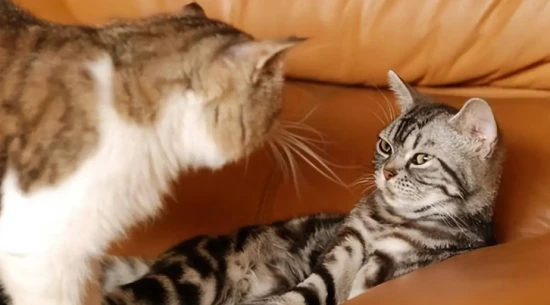
Yesterday we talked about the 7 meanings behind a cat's yawn. Today, let's discuss 8 tips for easing tension between cats.
Cat owners with only one cat can also take a look; after all, the country has already allowed three children per family, so it's time to consider having a second one.
Introducing a new cat requires patience and skill. Some cats take a long time to adjust to each other, while others seem unable to coexist peacefully. However, there are things we can do to help resolve their differences, prioritizing preventing arguments.
However, it's important to note that changes in a cat's behavior, such as aggression, hiding, or changes in appetite, may have underlying medical conditions. Therefore, before assuming the problem is entirely behavioral, it's crucial to determine if the cat is in good health and ideally, have it checked regularly.
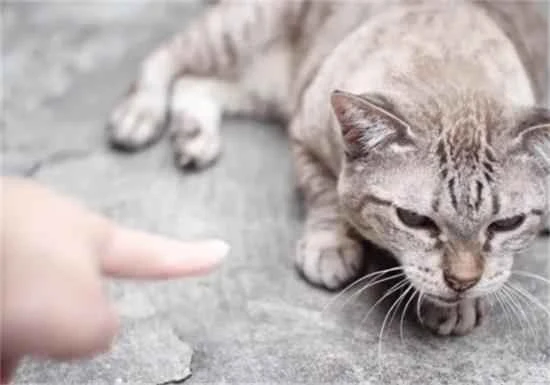
Now let's get down to the techniques!
Social Relations Survey
Before addressing a cat's socialization issues, we need to understand the social group dynamics among multiple cats:
Especially in multi-cat households with more than two cats, the cats often have multiple social groups. We need to take some time to really see who spends most of their time with whom (look at the small groups), or whether a particular cat tends to stay in a certain area of your house.
Cats that grow up together from kittenhood are more likely to form cliques and collectively exclude outsiders.
When arguments occur, do they always involve the same cat? Is it always directed at the same cat? (“Group bullying”) How does it or the other cat react when another cat, not a member of its group, tries to go to the litter box or to eat? (“Bullying behavior and frequency”)
Once we understand the social relationships of our cats, we can better address the issues in a targeted manner. For example, if Yellow and Black have a good relationship, but Yellow, Black, and White have a poor relationship, we can group Yellow and Black together, while White is in a separate group. This will make it easier to allocate territory and resources.
There are techniques for placing food.
Regarding food resources, I've seen many pet owners make the following common mistakes:
They prepared a food bowl for each cat, but the bowls were all lined up in a row or very close together, perhaps assuming that since the cats were willing to eat together, they must get along very well.
In reality, the cats might be very nervous, but because it's the only place where the food is, they are forced to eat together.
In this situation, you might see one cat guarding its food, constantly bullying another or several other cats, forcing them to stay away from the food bowl.
The lower-ranking cat (the weaker one) in a hierarchy might quickly learn not to approach the food bowl until the stronger cats have finished eating, enduring hunger and waiting for the other cats to finish before licking the plate. Humans might perceive this as humility, but it could actually be a form of bullying.
The image below is an example:
The white cat in the picture is making a circling motion, which fully illustrates that their relationship is not good. In the orange cat's eyes, all three bowls are its food, and the white one is an "intruder". So, when the white cat comes to eat, the orange cat immediately moves the bowl to defend its food.
The correct approach should be:
① Each cat has its own food bowl.
② Establish feeding stations (delineate feeding areas) based on small groups:
I know that placing food bowls haphazardly isn't very practical for multi-cat households. So, we can arrange them according to their small groups to create a more peaceful and separate dining environment. Cats in the same small group can eat at the same time, and at most, they might feel slightly unhappy, but there won't be any bullying or stress issues.
By setting up feeding stations, cats from one group will not be forced to enter another group's territory to eat.
The placement of feeding stations depends on the specific cats. For some cats, eating in the same room, but not right next to each other, may be sufficient. However, for others, they may need a separate room in their own territory.
PS: Tip: Cats in multi-cat households often have their own territories. Observe where your cat usually stays and set up the feeding station in that location.
③ Pay attention to the specific location of your feeding station, that is, make sure the food bowl is placed in a place where the cat can see it clearly.
Even if you place food and water bowls in multiple locations, always make sure to put them in the place where your cat feels the safest.
I've found that a timid cat might prefer to hide completely while eating, or prefer to be in a high place, because this gives it the best visual range and reduces the chance of being ambushed.
There's no rule that all food bowls have to be on the kitchen floor. Just put them where it's most convenient for your cat.
There are tricks to placing a cat litter box.
The trick is:
① Place the litter box in a place where the cat can see its surroundings and feels safe.
In nature, cats are not only predators but can also be prey. Because urination and defecation make cats vulnerable to attacks from potential predators, cats require safe places to relieve themselves.
You need to put the litter box in a place where she feels no one will bother her.
② In households with multiple cats, ensure that the cat's route to the litter box is not blocked by an opponent.
One mistake we easily make is ignoring a cat's territorial instincts. You may have enough litter boxes, but what causes stress isn't the number of litter boxes, but the relationships between the cats.
In a multi-cat home, cats may already be forced to tolerate overlapping personal territories. If their relationship is strained, they may become reluctant to cross into other cats' preferred areas to reach the litter box, and having to do so will only exacerbate the tension.
For lower-status or fearful cats, it may be less stressful to relieve themselves on the carpet in their own territory rather than risk encountering confrontation or ambush.
Therefore, what we need to do is to distribute the litter boxes throughout the house according to the cats' territorial divisions, covering the places each cat likes. This way, the cats won't have a strained relationship due to excretion issues.
Other resource issues
Besides food and waste disposal, other resource allocation is equally important: such as scratching posts, cat trees, cat toys, and cat beds.
If the only cat tree or similar equipment in a multi-cat household is located in a room controlled by a particular cat, consider adding the corresponding equipment in other areas.
Cat caught by a small group
One of the keys to peaceful coexistence in the world is the supply of resources.
Don't put all the resources and equipment your cats need in one place. Even if you prepare multiple copies, putting them in the same area is like ineffective resource allocation. They will have to bully cats that are not in their group to defend their resources. Each cat will want to have certain resources, which will lead to increasingly tense relationships and even a fight for dominance.
Properly introducing new cats
Many strained relationships between cats stem from poor initial introduction procedures, leading to a persistently tense and unpleasant bond. Therefore, the process of introducing a new cat is extremely important.
We need to take the time to introduce things gradually and positively. Minimize stress, fear, and threats.
Please remember that when a new cat enters completely unfamiliar territory, it's essential to introduce it to people and animals it has never seen before. The new environment and unfamiliar smells can make it worry about being attacked.
For indigenous people, an intruder in their home could threaten their territory, steal resources, and threaten their security.
The first meeting was not successful.
Therefore, the bottom line for introducing a new cat is: give the cat a reason to like the other cat.
I will write a separate article about the specific methods, but here I will just briefly mention the following keywords:
① Isolation
② Scent exchange and communication
③ Eye contact
④ Actively connect
Add vertical area
Cats need personal space, and the best way to reduce conflict is to have their own territories where they don't disturb each other.
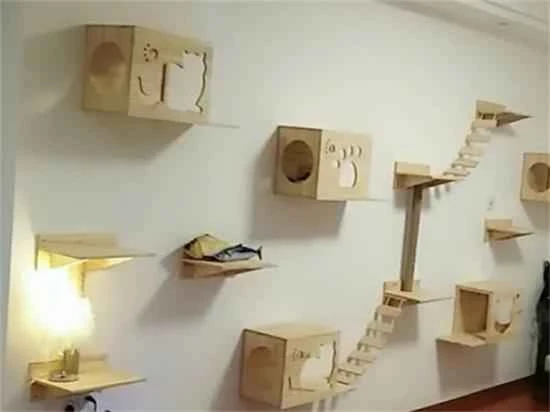
One of the best ways to increase the land area within a multi-family home is to increase vertical space.
We humans live in a horizontal world, while cats see their world vertically.
We can add cat trees, cat stairs, cat windowsills, and towering pillars to double or triple the area of each cat.
A multi-purpose cat tree is also a great way for cats to share space by the window while still feeling that they are keeping enough distance between them, because they are not just next to each other.
The staggered cat shelves also allow cats to choose their own height. If designed correctly, cats can move freely up and down without having to interact with other cats.
Reduce contact naturally reduces friction
Increase environmental richness
Cats are naturally energetic and curious, as if they were born to love running around and hunting.
When cats have nothing to do, one cat may try to engage in some social games, but the other cat may misinterpret this as unfriendly, thus causing the relationship to deteriorate and become tense for no reason due to misunderstanding.
Especially between cats of different personalities and ages, misunderstandings often arise due to the generation gap.
Increasing environmental richness includes:
① Increase interactive playtime: Spend more time playing with your cats, and make sure to give them equal attention to each individual.
② Provide some toys that the cat can play with on its own. For example, some cats like to play with toy mice, while others like to play with ping-pong balls.
③ Set up some fun equipment, in addition to the usual cat trees, there are also some cat tunnels and other equipment.
④ Allow the cat to observe the world outside the window.
Don't punish your cat
If your cats don't get along, it could be because one of them feels threatened or scared, or the environment hasn't been established and isn't providing enough resources.
In short, never punish your cat. Any form of punishment, such as yelling at it, spraying it with water, spanking it, or hitting its head, will only increase their mutual resentment. Punishment will also cause your cat to become afraid of you.
Another side effect of punishment is that the punished cat may transfer its anger to another cat, secretly bullying it behind your back.
If the cats don't get along, what we need to do is patiently find out the reason and solve it. At worst, we can separate them for a few days and then start all over again from the steps of reintroducing them. The worst-case scenario is permanent isolation, with one cat per room.